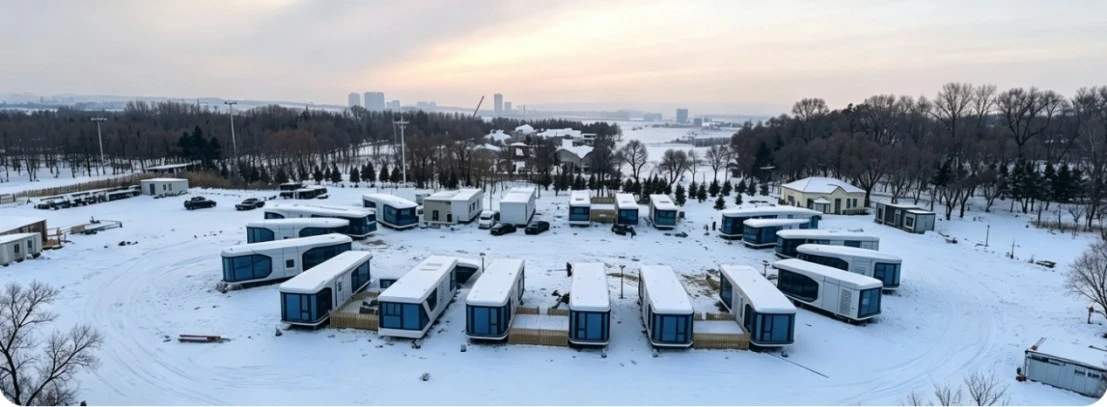
In winter, many people want to go see snow, watch auroras, and live in snowy mountains and forests. Their first reaction is: Will those thin "spacecraft" be as cold as an ice cellar?
How low can mainstream spacecraft withstand? Firstly, let's draw a conclusion: Legitimate industrial grade spacecraft on the market can generally adapt to extreme low temperatures ranging from minus 30 ℃ to minus 40 ℃. Some products specifically developed for high-altitude regions are marked with an adaptation range of up to -40 ℃ to 55 ℃ - for example, spacecraft from domestic manufacturers are specifically designed to solve winter insulation problems in extremely cold regions such as Russia and North America; There are also project records of products running continuously without faults for 60 days in an environment of minus 35 ℃. That is to say, from the snowy countryside of Northeast China to the grasslands of Inner Mongolia, from the Qinghai Tibet Plateau to Russia at sea, spacecraft can basically 'withstand' it.
However, it should be noted that "able to withstand" has two levels: the cabin structure does not have any problems: it does not crack, deform, or fail to seal at low temperatures, and it does not collapse under heavy snow pressure; Comfortable living inside the cabin: with sufficient insulation performance and air conditioning or underfloor heating, the indoor temperature can be stably maintained above 20 ℃. Both legitimate products can achieve this; However, low-priced and low-quality cabins priced at tens of thousands of yuan often only have the shape of a "spacecraft", leaking air, freezing, and condensing at temperatures as low as minus ten degrees Celsius, experiencing a cliff like descent.

Why is a spacecraft cold resistant? It relies on three layers of hard work
The wall of the spacecraft is not a piece of iron sheet, but a "sandwich" structure - an outer aluminum alloy panel, a middle polyurethane insulation layer, and an inner decorative panel. The insulation layer in the middle has a thickness of about 75mm for ordinary models and up to 150mm for high-altitude enhanced models. A cabin with good insulation performance can achieve a heat transfer coefficient K value of less than 0.5W/(㎡· K) - equivalent to wearing a thick down jacket for the entire room.
Many spacecraft use double-layer broken bridge aluminum structures, with insulation materials "disconnected" between the inside and outside of the metal frame, preventing heat transfer and cold air from entering. This is also the same technology as high-end doors and windows in the north.
Regular products use 5+12A+5 or even 6+16A+6 hollow Low-E tempered glass, which locks in indoor heat in winter, blocks sunlight exposure in summer, and can be upgraded to three layers of glass in high-altitude areas.